
reflection · 15 August, 2026
The Freedom Within: Yoga and the Journey to Inner Independence
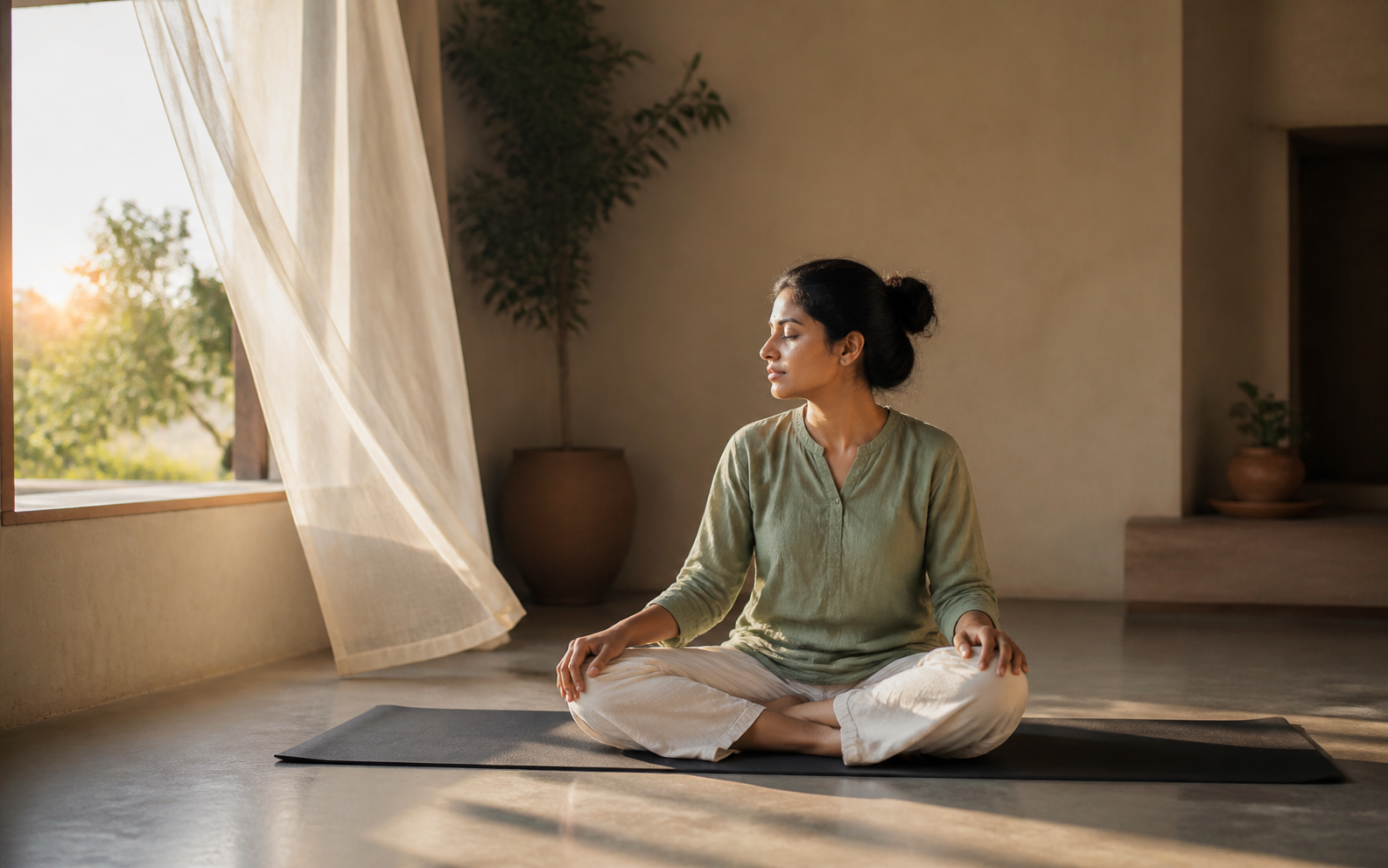
On the morning of 15 August, India wakes to the colours of the flag, familiar songs, and stories of courage. Independence Day honours a freedom that can be seen in the life of a nation: the right to choose its own direction and shape its own future. Yet the day also leaves us with a quieter, more intimate question. In the private country of our thoughts, emotions, and habits, do we feel free?
Many of the forces that govern us now do not look like chains. They sound like a mind rehearsing tomorrow at midnight. They feel like anger that speaks before wisdom can arrive, shoulders that never quite drop, or the pressure to satisfy expectations we did not consciously choose. Yoga does not ask us to escape these experiences. It teaches us to meet them so steadily that, little by little, they lose the power to rule us.
When the mind loosens its grip
A restless mind can feel like a room where every voice is speaking at once. One thought revisits the past, another predicts disaster, and a third insists that everything must be solved immediately. The more we try to force silence, the louder the room can become. The first mental freedom yoga offers is not an empty mind, but enough space to hear a thought without becoming captive to it.
On the mat, attention has somewhere gentle to return: the contact of the feet with the ground, the movement of the ribs, the next breath. In pranayama, the rhythm of breathing becomes an anchor. Awareness begins to notice the mind’s movement instead of being swept along by every current. Over time, a simple but profound distinction appears: a thought is something passing through us, not an order we must obey. Anxiety may still knock at the door, but it no longer has to occupy the whole house.
The freedom to feel without being ruled
Emotions bring their own weather. A sharp word can summon a storm; disappointment can colour an entire day. When there is no inner space, feeling and reaction seem to happen in the same instant. We defend, withdraw, or strike back before we have truly understood what moved through us.
Yoga slowly widens that instant. A conscious breath, a moment of stillness, the patience to observe sensation—these create a pause where choice can return. Meditation deepens this freedom by teaching us to sit beside what we feel without suppressing it or handing it the reins. Anger, sadness, fear, and joy remain real; inner independence does not make us indifferent. It makes us spacious enough to feel fully and still decide how we wish to respond. The emotion is honoured, but it is no longer the ruler.
Coming home to the body
The body often carries what the mind has not put down. Tension gathers in the jaw and neck. Fatigue settles into the back. Breath becomes shallow, and the body can begin to feel like a place of limitation—a weight to drag through the day, or an object that must be corrected before it is acceptable.
Asana offers another kind of liberation. Not the freedom to perform an impressive shape, but the freedom to inhabit the body without being at war with it. In attentive movement, we notice where effort has hardened into strain and where fear has made us hold back. We learn that strength can exist without aggression and softness without collapse. A pose becomes a conversation rather than a command. The body may still have tired days and firm boundaries, yet it feels less like a cage when we can listen to it with respect. We come home to ourselves through sensation.
Releasing the need to control
Beyond the mind and body lies another subtle captivity: the need to manage how life unfolds and how others see us. Family roles, work culture, comparison, and old conditioning can quietly write the rules by which we measure our worth. We chase approval, resist uncertainty, and hold our plans so tightly that even a small disruption feels like defeat.
Yoga reveals this habit in small, honest ways. We may force the pose, hold the breath, or judge ourselves against the person on another screen. Practice asks whether we can stay present without demanding that the moment become different first. That is not passivity. It is the wisdom to act where action is ours and to unclench around what is not. External pressure does not disappear, but it no longer gets unquestioned authority over our inner life. We begin to choose which voices deserve to guide us.
Inner independence
These freedoms do not arrive all at once. They unfold layer by layer. Asana creates room in the body. Pranayama steadies the inner rhythm. Meditation lets us witness thoughts and emotions without immediately becoming them. Awareness carries that steadiness beyond the mat—into a difficult conversation, a crowded commute, an uncertain decision, or a day when nothing follows the plan.
This is yoga’s quiet form of self-governance. It is not a life untouched by chaos; it is the capacity to remain rooted while chaos moves around us. It is responding from values rather than reflex, resting without guilt, and meeting change without surrendering our centre. The freedom our country honours was not won so that life would never be difficult. It was won so that its direction would not be commanded from outside. Inner freedom asks something similar of each of us.
When we are no longer consumed by every thought, tossed by every emotion, or ruled by every expectation, we do not withdraw from the world. We meet it more clearly. We can listen without preparing a defence, care without trying to control, and act without needing fear to drive us. Our steadiness becomes a quiet contribution to the people and communities around us.
As India marks another year of independence, perhaps we can honour freedom in both its vast and intimate forms. Beyond the celebrations, there is a territory within that no one else can govern for us. Yoga invites us to enter it patiently—through movement, breath, stillness, and awareness—and discover what becomes possible when we are truly at home in ourselves. The journey need not begin dramatically. It can begin with one practice, one conscious breath, and a little more room inside.
Begin your own journey inward
Join a free live Kosha session and give yourself the space to move, breathe, and become still.
Claim Your Free Spot