
yoga philosophy · 19 August, 2026
Pancha Kosha: The Five Layers of Wholeness Behind the Kosha Name
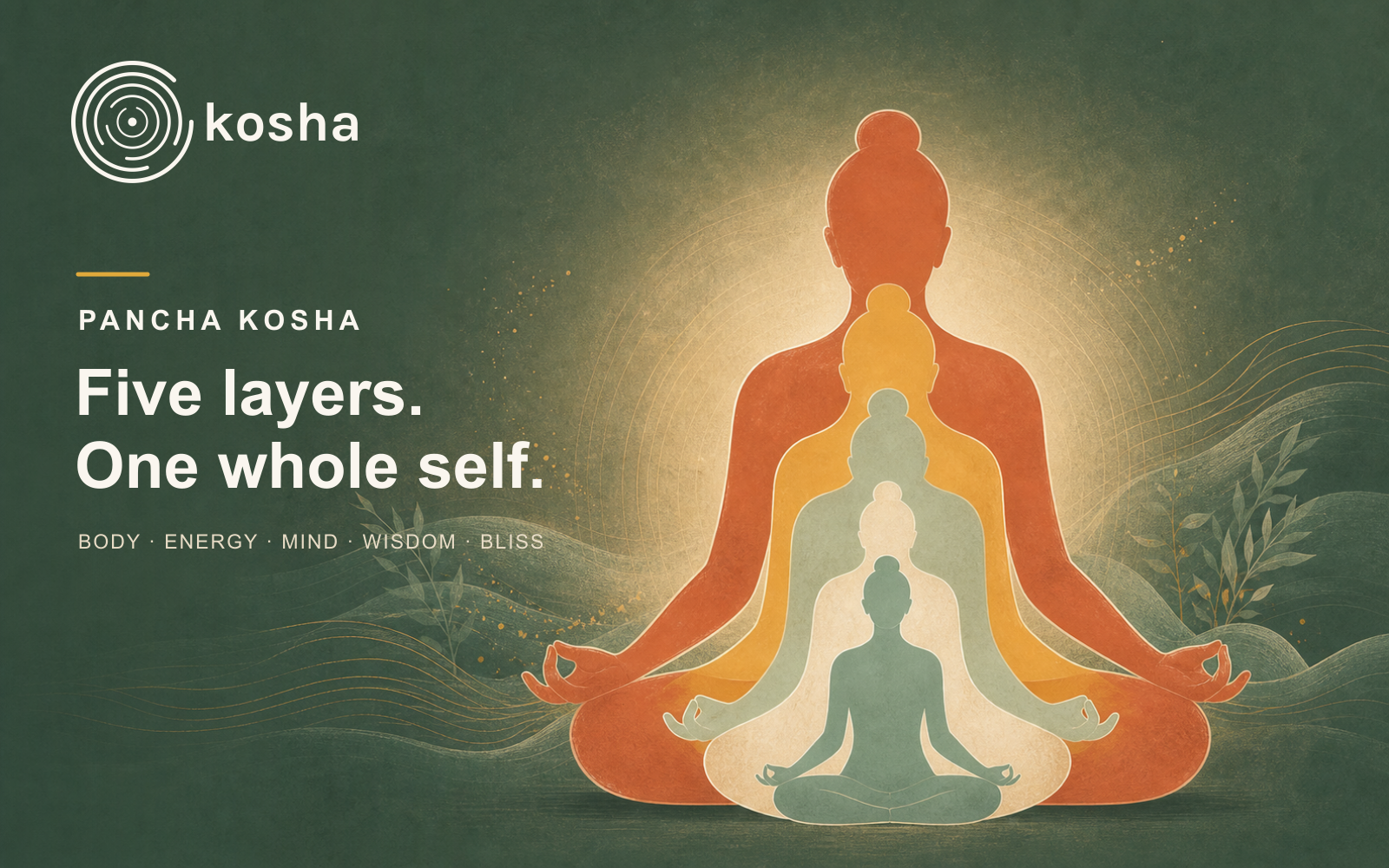
We often speak about wellbeing as though it can be divided into neat pieces. The body belongs to exercise, the breath to relaxation, the mind to concentration, and happiness to whatever remains. Lived experience tells a different story. A tired body changes the quality of our thoughts. An anxious mind shortens the breath. One quiet breath can soften an emotion and make a wiser response possible. We are not a collection of separate parts; we are a whole person, felt through many dimensions.
This understanding is at the heart of the name kosha. It comes from Pancha Kosha, an ancient Vedantic teaching found in the Taittiriya Upanishad. The teaching offers a way of seeing the human being as five interconnected sheaths, moving from the tangible physical body toward subtler experiences of energy, mind, understanding, and deep contentment. It is both a map of the self and an invitation to look beyond the surface.
What does Pancha Kosha mean?
Pancha means five, while kosha is commonly translated as sheath, covering, or layer. A sheath is not a sealed compartment. Think instead of five dimensions that rest within and move through one another, like circles sharing the same centre. Each influences the rest, and no single layer tells the whole story of who we are.
In Vedanta, the koshas also help us examine where we place our identity. We may say, “I am my body,” “I am my thoughts,” or “I am this feeling.” The five-sheath teaching gently asks us to notice each experience without mistaking any one of them for the entirety of the Self. It does not reject the layers. It invites us to know them, care for them, and see beyond our habitual identifications.
Annamaya Kosha: the physical sheath
Anna means food. Annamaya Kosha is the body formed and sustained by nourishment: bones and muscles, skin and organs, strength and fatigue. It is the layer we can touch and see, and often the first doorway into yoga. When asana is practised with attention rather than force, the body becomes more than an object to improve. It becomes a source of honest information. Tightness, ease, balance, and tiredness all have something to say.
Caring for this sheath means meeting the body with respect. Movement, rest, food, and recovery are not rewards for perfect performance; they are part of living well. Yoga begins here because the body brings us unmistakably into the present.
Pranamaya Kosha: the vital sheath
Beneath the visible form is Pranamaya Kosha, associated with prana—the vital energy of life—and experienced closely through breath. We know this layer when energy feels bright or depleted, when the breath opens under relief or catches under stress. It reminds us that being alive is rhythmic, not mechanical.
In yoga, breath and movement begin to speak to each other. Pranayama makes that relationship more conscious. Without demanding a particular mood, a steadier rhythm can create enough inner space for the rest of us to settle. Breath becomes a bridge between what is physical and what is subtle.
Manomaya Kosha: the mental-emotional sheath
Manomaya Kosha is the realm of thought, emotion, memory, and sensory impression. It is the inner weather that can shift before the outer day has changed at all. This layer interprets experience quickly: pleasant or unpleasant, safe or uncertain, wanted or resisted. Left unnoticed, those interpretations can become the voice that runs our lives.
Yoga does not promise a permanently quiet mind. It helps us develop a different relationship with its movement. In meditation and mindful practice, a thought can be witnessed without being followed, and a feeling can be honoured without immediately becoming a reaction. The mind remains active, but it need not hold unquestioned authority.
Vijnanamaya Kosha: the wisdom sheath
Vijnanamaya Kosha is often described as the sheath of intellect, knowledge, or discernment. It is more than collecting information. It is the capacity to see clearly, recognise patterns, examine assumptions, and choose according to what we understand to be true. Where the mind reacts, discernment pauses and asks, “What is really needed here?”
Practice strengthens this inner compass in quiet ways. We learn when effort is useful and when it has become aggression. We notice the difference between a genuine boundary and a familiar fear. This is wisdom becoming lived rather than merely known.
Anandamaya Kosha: the bliss sheath
Anandamaya Kosha is the most subtle of the five and is associated with ananda, or bliss. This does not mean constant cheerfulness or escape from difficult emotions. It points toward a deeper ease that is not dependent on every circumstance going our way—the quiet sense of being whole, even for a moment.
We may glimpse it after a practice when striving drops away, in stillness that feels spacious rather than empty, or in a moment of connection without self-consciousness. Vedanta does not make bliss another achievement to chase. Even this subtle sheath is something to be observed on the inward journey toward the deepest Self.
Why the name kosha matters to us
The kosha yoga brand was shaped by this vision of the whole person. Our name is a reminder that yoga is never only about the pose visible on a screen. A thoughtful practice may begin with the physical body, travel through the rhythm of breath, meet the activity of the mind, awaken clearer choices, and leave behind a little more ease. The layers are distinct, but the experience is one.
Our five-ring symbol carries the same idea. Each open circle can be read as one kosha: connected to the others, always in movement, and gathered around a still centre. The mark does not suggest that people need to be made complete. It reflects our belief that wholeness is already present, even when one layer feels tired, noisy, disconnected, or difficult to reach.
Shaping a practice for the whole person
Pancha Kosha gives kosha a simple question to return to: are we caring for the whole person? Some days the answer begins with movement that makes the body feel inhabitable. On others, it is a breath that steadies scattered energy, a pause that softens a reaction, or the clarity to choose rest. No two people enter through exactly the same layer, and no meaningful practice shapes everyone into the same form.
Instead, yoga can help each of us become more integrated—more able to listen across the layers and respond with care. A strong body without rest is not whole. Calm without discernment is incomplete. Knowledge that never reaches daily choices remains distant. When body, breath, mind, wisdom, and inner ease begin to support one another, wellbeing feels less like a target and more like a way of living.
The five sheaths offer a map, not a finish line. At kosha, they remind us to begin wherever we are and to remain curious about what lies within. One movement, one conscious breath, one moment of clear seeing: each can open a path toward the centre. The invitation is not to become someone else, but to meet more of who we already are.
Meet yourself, layer by layer
Join a free live Kosha session and explore movement, breath, awareness, and stillness as one connected practice.
Claim Your Free Spot